When Did CMS Get Renamed DXP? A Veteran's Perspective on Platform Evolution
The shift from CMS to DXP formalized in 2017 when Forrester and Gartner created new analyst categories. But the technology hadn't changed—the marketing narrative had.
Around 2017, something curious happened in our industry. The software I'd been implementing for fifteen years under the banner of "Content Management System" suddenly needed a new name. Vendors started calling it a "Digital Experience Platform" instead. If you're wondering when CMS became DXP and why, you're asking the right question.
I've built on every major platform over three decades. I watched this transformation unfold not from a conference stage or analyst report, but from the trenches of actual implementations. The shift from CMS to DXP wasn't really about the technology changing. It was about the market trying to catch up with what we'd been building all along.
The Official Timeline: When Analysts Made It Real
The DXP category gained legitimacy through two key moments in 2017-2018. Forrester Research published their first Wave report on Digital Experience Platforms in Q3 2017, authored by Mark Grannan. A few months later in January 2018, Gartner followed with their first Magic Quadrant for Digital Experience Platforms, which evolved from their previous "Horizontal Portals" research.
These weren't just new reports with fresh branding. They represented a fundamental shift in how analyst firms classified enterprise software. Gartner had been tracking horizontal portals since 2008. Forrester had covered web content management for years. Both firms recognized that their existing categories no longer captured what these platforms had become.
The timing makes sense when you consider the broader digital landscape of 2017. Mobile had fully matured. IoT devices were proliferating. Customer data platforms were emerging. Marketing automation had become table stakes. The technology that powered digital experiences had exploded in complexity, and the old "web content management" label felt inadequate.
What Actually Changed (And What Didn't)
Here's what I found interesting after building platforms before and after the DXP rebranding: not much changed in the actual software.
The capabilities that Gartner and Forrester used to define DXPs in 2017 were features I'd been implementing since 2008. Personalization based on user behavior. Content delivery across multiple channels. Integration with customer data. Marketing automation workflows. Asset management at scale. These weren't new innovations. They were capabilities that enterprise CMS platforms had been developing for a decade.
Tony Byrne of Real Story Group captured this well when he wrote in 2017 that "there is no such thing as a DXP." His point was that what analysts were calling a DXP was actually an assembled ecosystem of technologies from multiple vendors, not a single unified product. He was right then, and that observation holds true today.
What changed was the marketing narrative. Vendors needed a way to justify enterprise pricing and position themselves against the flood of newer, lighter CMS options entering the market. WordPress had proven you could publish content without enterprise budgets. Drupal offered powerful features as open source. The traditional enterprise CMS vendors needed to articulate why their platforms commanded higher prices.
The answer was scope. A CMS manages content. A DXP orchestrates experiences.
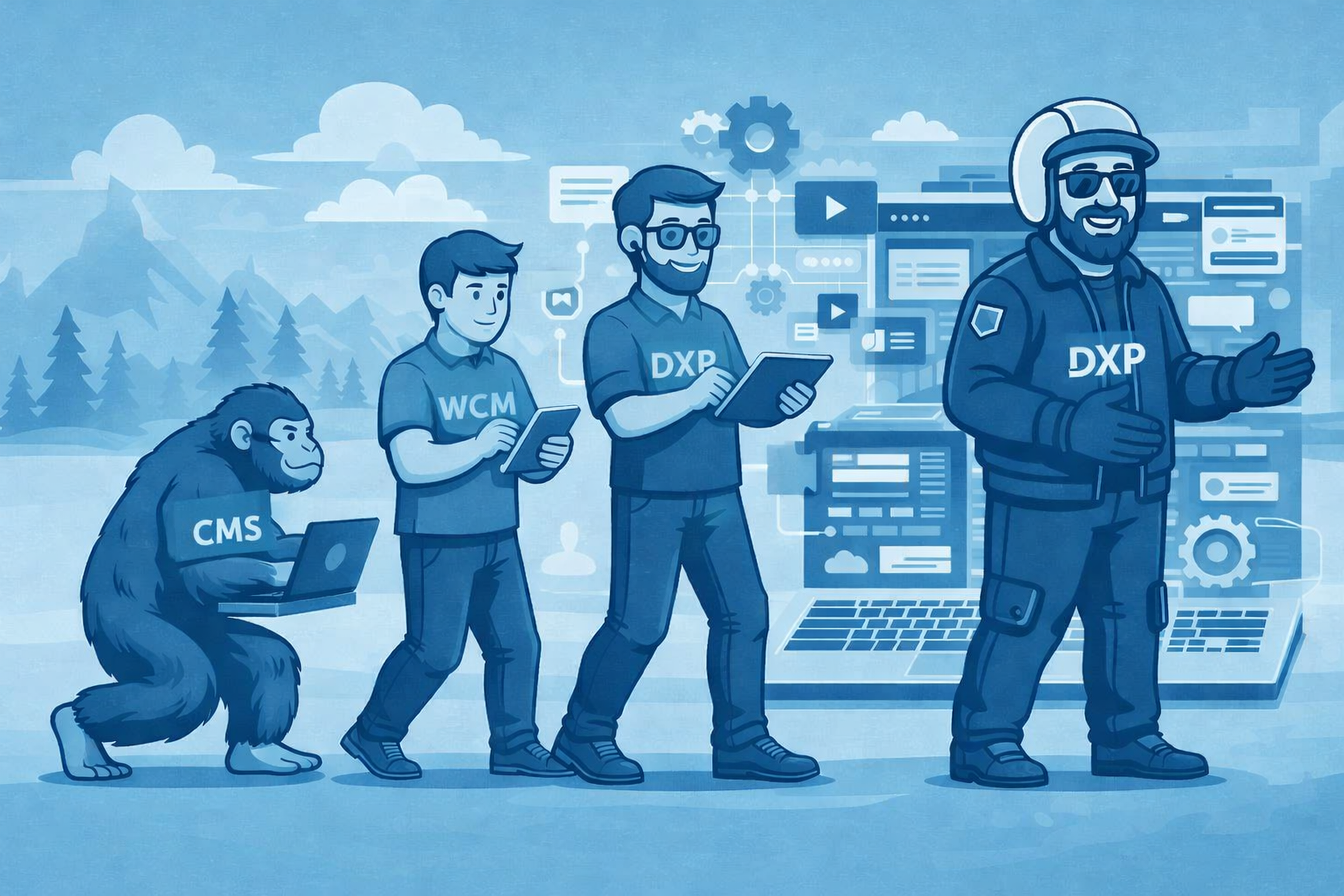
The Evolution: CMS to WCM to DXP
The path from CMS to DXP wasn't direct. There was an intermediate step that many people forget: Web Experience Management.
In the early 2010s, "WEM" emerged as vendors tried to signal they offered more than basic content publishing. WEM platforms promised to manage not just content but the entire web experience, including personalization, testing, and optimization. It was an accurate description of the technology but a terrible acronym that never quite stuck.
By 2017, vendors had moved past WEM and settled on DXP. The new label better captured the reality that digital experiences extended far beyond websites. You needed to reach customers on mobile apps, in kiosks, through IoT devices, via chatbots. The "web" in WEM felt limiting. "Digital Experience Platform" opened the tent wide enough to include everything.
Why Vendors Needed the Rebrand
I've watched enough platform vendors over the years to recognize certain patterns. The shift to DXP wasn't driven by technical innovation. It was driven by market positioning and business necessity.
Traditional enterprise CMS vendors faced pressure from multiple directions. Cloud-native competitors were offering headless architectures with lower total cost of ownership. Marketing teams were assembling their own stacks using best-of-breed tools. The monolithic CMS was being unbundled, and vendors needed to articulate why organizations should buy an integrated platform instead.
The DXP positioning gave them that answer. Yes, you could assemble your own stack from twenty different vendors. Or you could buy a DXP that integrated content management, digital asset management, personalization, analytics, and marketing automation from a single platform provider. The promise was coherence, governance, and a unified data model.
For vendors like Adobe, Sitecore, and Acquia, the DXP rebrand also justified the expansion of their product portfolios through acquisition. Adobe had acquired Omniture for analytics and Day Software for CMS capabilities. Sitecore had built out commerce and personalization features. These weren't just CMS companies anymore. They were assembling comprehensive platforms, and DXP became the term that encompassed that expanded scope.
What DXP Actually Means in Practice
After all these years, I've come to think of DXP less as a product category and more as a statement of architectural intent. When a platform calls itself a DXP, it's signaling several things:
It handles content as a foundation but extends beyond publishing. The CMS capabilities are still there, but they're joined by tools for personalization, analytics, testing, and optimization.
It supports delivery across multiple channels and devices. Content isn't just for websites anymore. The same asset might need to render on a mobile app, a digital sign, a voice interface, and a customer portal.
It integrates with broader marketing technology stacks. The platform can connect to CRM systems, marketing automation tools, e-commerce platforms, and customer data platforms to create unified customer experiences.
It provides tools for measuring and optimizing those experiences. Analytics and testing capabilities are built in, not bolted on afterward.
This is a fair description of what modern enterprise platforms actually do. The question I always ask clients is whether they need all of that integrated in one platform, or whether they'd be better served by a more focused CMS that integrates well with best-of-breed tools for the other capabilities.
The Reality Gap Between Marketing and Implementation
Here's what I've learned implementing these platforms: the gap between how vendors market DXPs and how organizations actually use them remains substantial.
Most companies that license a comprehensive DXP end up using a fraction of its capabilities. They need the content management features and maybe personalization. The advanced analytics, optimization, and orchestration features often go unused because implementing them requires dedicated teams, clean data, and organizational alignment that many companies simply don't have.
I've seen this pattern repeat across industries. An organization licenses Adobe Experience Manager or Sitecore Experience Platform. They deploy the CMS capabilities successfully. They get the digital asset management working. But the sophisticated personalization engine that justified the platform selection never quite gets implemented because the marketing team doesn't have the resources to build and maintain hundreds of targeted experiences.
This isn't a failure of the technology. It's a mismatch between platform capabilities and organizational readiness. The vendors market the full DXP vision. Organizations buy that vision but often lack the people, processes, and data maturity to execute on it.
Where We Stand Today
Eight years after the DXP category emerged, the conversation has shifted again. The new focus is on "composable DXP," which is essentially an acknowledgment that what Tony Byrne said in 2017 was correct all along.
Organizations don't want monolithic platforms that try to do everything. They want flexible architectures that let them assemble best-of-breed components. They want the freedom to swap out underperforming tools without replacing their entire stack. They want APIs and integration layers that make composition possible.
Gartner now predicts that by 2026, at least 70% of organizations will be mandated to acquire composable DXP technology rather than monolithic suites. We've come full circle, from integrated platforms to unbundled components back to integrated platforms and now to "composable" platforms that promise the best of both approaches.
The vendors who successfully rebranded from CMS to DXP in 2017 are now rebranding again to position themselves as composable. Sitecore has moved from monolithic platform to composable DXP with separate products for content, commerce, and personalization. Adobe is pushing composability within the Experience Cloud ecosystem. Even traditional portal vendors like Liferay emphasize their ability to integrate with external services.
What This Means for Platform Selection Today
If you're evaluating platforms now, here's what I'd suggest based on three decades of implementations:
Ignore the labels. Whether a vendor calls their product a CMS, a DXP, or a composable DXP matters less than understanding what capabilities you actually need and whether the platform delivers them reliably.
Understand your organizational capacity. The most sophisticated platform won't deliver value if your team lacks the skills, bandwidth, or data infrastructure to use its capabilities. Start with what you can execute on today, not what you aspire to do in three years.
Evaluate based on your actual use cases. Don't pay for DXP capabilities you won't use. If you need a solid CMS with good APIs for headless delivery, platforms like Sanity or Contentful might serve you better than a comprehensive DXP that includes features you'll never activate.
Consider the total cost of ownership over five years. The platform license is often the smallest part of the cost. Implementation, customization, training, hosting, and ongoing optimization typically dwarf the software expense. Choose based on long-term sustainability, not just initial capabilities.
The Evolution Continues
The shift from CMS to DXP that formalized in 2017 represented a real change in how organizations think about digital platforms. Content management alone wasn't enough. Companies needed tools to orchestrate complete customer experiences across channels and touchpoints.
But the rebrand also represented continuity. The core capabilities that make a platform valuable haven't changed as much as the marketing suggests. You still need to create content efficiently, manage it at scale, deliver it reliably, and measure its impact. Whether you call that a CMS or a DXP is less important than whether your platform and your organization can execute on those fundamentals well.
After thirty years of building digital platforms, I've watched many acronyms come and go. The technology evolves. The capabilities expand. The market positioning shifts. But the fundamental challenges remain constant: creating content that serves your audience, delivering it where they are, and building systems that your team can actually maintain over time.
The name on the box matters less than what you build with it.